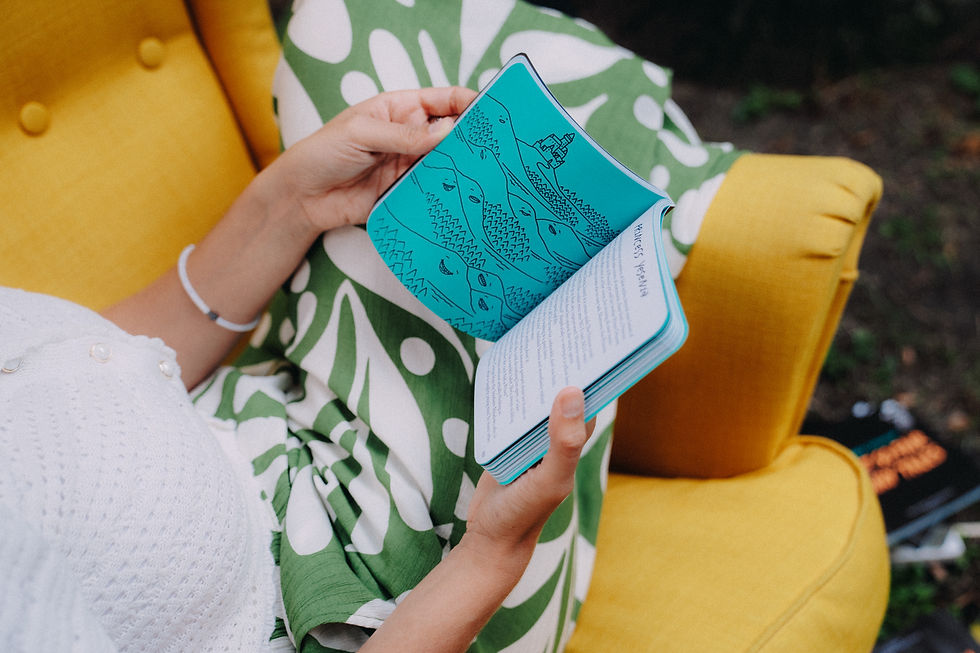
Not So Fair Fairy Tales: a way out of the vicious circle of self-destruction
A small book with big themes. For your bedside table and your handbag. Back to yourself.
Poor Little Plant steps aside for everyone. Princess Pleaseall wants everyone to be happy. And Prince Dreamalot? For now, he mostly dreams. Eight fairy tales and one not-quite-fairy-tale hold up a mirror to our everyday “I should” – with humour, illustrations and room for your own notes.
After all these years, feel free to read a fairy tale again, scribble in the book, laugh out loud at the illustrations without shame…



Not So Fair Fairy Tales: a way out of the vicious circle of self-destruction
A small book with big themes.
For your bedside table and your handbag. Back to yourself.

A quirky, funny, illustrated book built on an original idea:
every fairy tale has two different endings.
While the “bad” one mercilessly mirrors the consequences of our automatic programmes, the “good” one shows the way to authenticity and inner freedom. Questions for reflection and tips based on the principles of embodiment help too – they let you carry the change into your body, and so into your life.

In short, Not So Fair Fairy Tales are the perfect read for anyone who wants to finally start writing their own happy ending.
Curious what’s inside? Flip through the book!
Knowing you can say no is the beginning. Trying out your own voice, movement and space can be the next step.

A taste of the fairy tale
Far, far away, beyond nine mountains of self-blame, beyond nine forests of people-pleasing and beyond nine oceans of giving in, lay the island of Borneo. It was famous for its gigantic jungle, recorded in the Guinness Book of Records. And as is the way in rainforests, the organisms there fought each other for their very lives. A spot in the sun, a patch of soil, a drop of water – only those who fought hardest got any of it. One night, as the constellation of the Naive Softie gave way to the White Gerbera, two seed leaves of an extraordinary plant sprouted in the middle of the deepest jungle thicket. The Cocoa Tree saw her first, so it claimed the role of fairy godmother and declared: “I give you the gifts of beauty and size! You will be a magnificent, enormous plant, the most beautiful the world has ever seen!” The second self-appointed fairy godmother, the noble Liliana gutensis, nodded: “Yes, yes, you will.” Out of nowhere, the unpopular, poisonous Podražec hissed from the dark undergrowth: “Since nobody invited me to this birthday party, I curse you, you miserable green seed! You will be a burden to everyone around you. You will take up all the space and nutrients we need to survive!” “Yes, you will take them,” whispered Liliana, and sighed with fake pity: “Oh, the poor little thing. Nobody will ever like her.” She had no wish to undo the bitter godmother’s nasty prophecy. After that she kept stubbornly silent. “Yes! Poor Thing! That’s her name! So many plants will drop dead because of her!” the prickly Locust Tree wrapped up this impromptu gathering, and every plant went its own way. Every plant except the Little Plant. Her first impressions of this world had terrified her. “I don’t want to hurt anyone – quite the opposite!” she told herself. Poor Little Plant noticed a flower called Ficusa filutila, who seemed noble and wise. Poor Thing asked the elegant lady of the forest for advice on how to live in the jungle as rightly as possible. But Ficusa was wicked and cunning. “If she lives, there won’t be enough room for me,” she thought, and then turned to the Little Plant with a condescending smile: “It’s simple, darling. Others are much more important and useful than you, you know? Step aside for them, don’t cast shade, don’t get in the way, take as few nutrients as you can. And try trimming yourself regularly, like houseplants do. You can do it, you’re wonderful!” “Oh, thank you ever so much,” replied a delighted Poor Thing. Poor Little Plant had no one else to advise her. She was a self-made sprout. She believed Ficusa’s words and started living by them. She became the most considerate inhabitant of the whole phytosphere. Her permanent posture was a humble bow with curled-up leaves, because that took up the least space. Soon rumours about the naive Poor Little Plant spread all over the jungle. Once Poor Thing gallantly made room for the Banana Tree; another time an old bush died and she left the spot to the Orchid. She denied herself water and cut her daily nutrients to a minimum. She went beyond the limits of her plant abilities to help others. The plant tried as hard as she could not to be in anyone’s way. But in the jungle, someone will always be in someone’s way. So although Poor Thing shrank herself with all her might, she was tormented by constant pangs of conscience that she was doing something wrong...
Which ending will you choose? The good one or the bad one? Will Poor Little Plant keep shrinking until she wilts away? Or will she stand up for herself, start to grow – and maybe even bloom?
Igy Ondra Hnízda
Conductor and musician
“Huge admiration for how beautifully, readably and lightly you handled such complex topics that trouble all the ‘would-be nice’ but actually self-destructive people. I devoured the book in one go. It’s truly worth it.”
Květa Trávníčková
Scientist
“What I’ve read so far has warmed my heart and soul. I admire how aptly you describe human fears and feelings of not being enough, and how bravely you stood up to them. A colleague I gave the book to says it feels as if it was written just for her.”
Helena Farkasová
Photographer
“I really love the playful form of the book and the colourful highlighted texts, quotes and notes. And then the exercises and space for notes. So even for me the book is very easy to digest, readable, and a good size to carry in your handbag.”
Jitka Hanáková
Mum of four
“At the very least you can check where you neglect yourself and how you set boundaries with yourself and others. And it’s an easy, fairly quick read, which I appreciate with kids, because sadly I don’t have much time for reading.”